
Lumbar punctures (LPs), remain a critical diagnostic procedure in pediatrics, providing essential cerebrospinal fluid (CSF) information for conditions affecting the brain and spinal cord. Prompt and accurate identification of the conditions diagnosed by LPs are essential to guide treatments in a timely manner. In infants and children, smaller anatomy and unique procedural considerations heighten the need for precise technique and familiarity with age-specific landmarks.
The success rate for LP procedures in children is alarmingly low, with Nigrovic (2007) finding that 35% of LPs in children were unsuccessful and had to be repeated. That said, in the same study, physician experience was independently associated with a decreased likelihood of a traumatic or unsuccessful LP. Unsuccessful LP attempts can pose significant health risks to children. With a failed LP, children may experience misdiagnosis, unnecessary antibiotic use and hospitalization [1]. Additionally, if the LP is traumatic or unsuccessful, the child may undergo multiple subsequent and potentially uncomfortable LP attempts [1].
Recent studies have highlighted the benefits of point-of-care ultrasound (PoCUS) prior to performing LPs, especially with its ability to aid in the identification of relevant spinal anatomy. As PoCUS expands in pediatric practice, evidence is steadily growing to demonstrate its clinical utility and accuracy as an adjunct landmarking tool, particularly in young infants and children anticipated to have a technically challenging LP.
Why Ultrasound?
Traditionally, LPs are performed without pre-procedural imaging and rely primarily on palpation to identify bony landmarks. In pediatric patients, this can be particularly challenging due to the small size of infants and young children and lack of cooperation of this age group [2].
PoCUS allows for the visualization of internal anatomical landmarks that physicians do not readily have access to, like the depth of the ligamentum flavum, width of the interspinous spaces, and spinal bone abnormalities [3]. It is particularly valuable in neonates and infants up to 12 months of age, where incomplete ossification of the spinal canal bones enables clear imaging of the spinal cord and dural margins [4]. An additional benefit of ultrasound is the detection of epidural or intrathecal hematomas following a traumatic or unsuccessful LP attempt, allowing physicians to assess the insertion site before considering a repeat procedure, which is important because the success rate of a repeat LP in the presence of a large hematoma is very low [5].
A recent systematic review and meta-analysis of ultrasound-assisted LPs in 618 children demonstrated several key benefits including higher overall success rates, fewer traumatic LPs and fewer failed attempts, when compared with the standard palpation-based technique (table 1) [6].
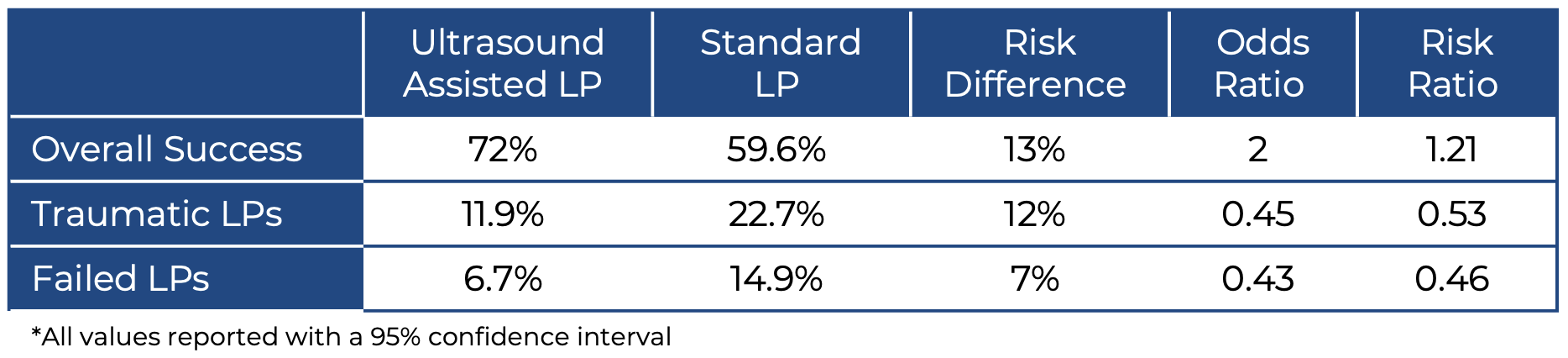
That said, the evidence is not conclusive. Several studies on the use of PoCUS for landmarking LPs in children have also shown that while there is a trend of improved successful LPs and fewer traumatic LPs when using ultrasound guidance, the differences remain insignificant [7-9]. This suggests that the integration of PoCUS into the LP procedure should be individualized and based on the broader clinical picture, including the child’s age, body habitus, cooperation, history of previous failed or difficult LP attempts and spinal anatomy, and the users comfort level with PoCUS.
PoCUS-guided LP is a skill that can be readily acquired through focused training combining didactic instruction and hands-on practice [7, 10]. Additionally, it has been shown to add only minimal time to the procedure [6], demonstrating that it can be performed efficiently in clinical practice, even by novice POCUS users, making it practical for routine use in pediatric settings.
PoCUS use for LP assistance in infants and children is supported by multiple professional bodies, including the American Academy of Pediatrics through its PEM fellowship training guidelines [11] and the Canadian Paediatric Society Fetus And Newborn Committee [12].