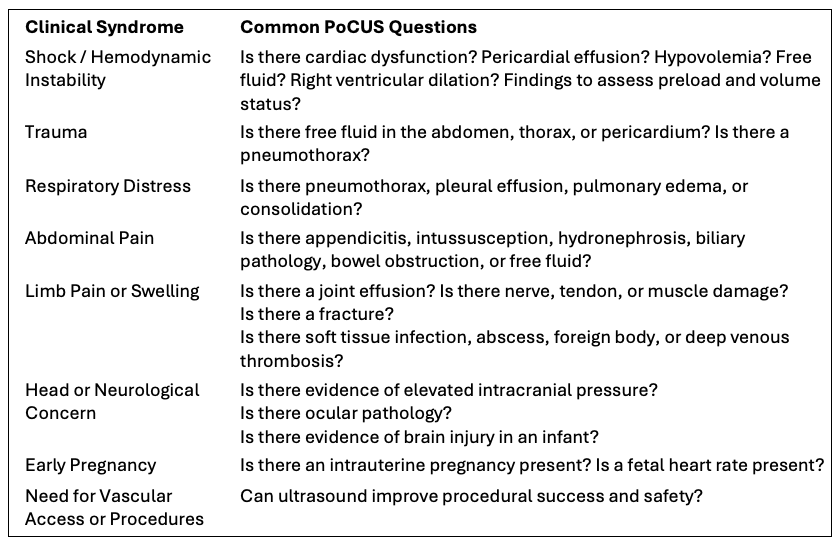
PoCUS can be applied across a wide range of clinical scenarios and specialties. While specific applications vary by profession and practice setting, most examinations are performed to answer focused clinical questions that arise during patient assessment. The American College of Emergency Physicians describes five broad areas of PoCUS practice: resuscitation, diagnosis, procedural guidance, symptom or sign evaluation, and therapeutic or monitoring applications [5].
Rather than viewing PoCUS as a collection of individual examinations, it is often helpful to consider its use within a syndrome-based framework. In practice, PoCUS is frequently integrated with clinical assessment tools, decision rules, and clinical pathways to support patient management.
Across emergency medicine, pediatrics, critical care, and generalist practice and specialties, several PoCUS applications have emerged as foundational competencies. Common examples include shock assessment, trauma assessment, focused cardiac ultrasound, thoracic ultrasound, urinary tract assessment, biliary imaging, soft tissue and musculoskeletal examinations, ocular and neural ultrasound, bowel applications and ultrasound-guided procedures [5-9].
The specific applications expected of a clinician will depend on their patient population, practice environment, training, and local scope of practice.
Table 1: Common Clinical Syndromes and PoCUS Applications