The Role of PoCUS
PoCUS is a focused imaging modality that can be used as an adjunct to clinical assessment. Rather than replacing clinical assessment, PoCUS complements it by providing additional bedside information that helps clinicians evaluate signs and symptoms, narrow the differential diagnosis, and rapidly answer focused clinical questions [1]. Because PoCUS can be performed wherever patient assessment occurs, it is often integrated directly into routine clinical care by physicians, residents, nurses, and allied health professionals [1].
Unlike comprehensive imaging studies, PoCUS is intentionally focused. PoCUS examinations are designed to answer specific clinical questions using a limited number of targeted views [1]. For example, a clinician may ask: Is there a pericardial effusion? Is there free fluid in the abdomen? Is hydronephrosis present or absent? By focusing on binary or relatively narrow clinical questions, PoCUS can provide rapid bedside information that supports clinical decision-making.
PoCUS offers several advantages as an adjunct to clinical assessment. It provides rapid bedside information that can support earlier diagnosis and management, including reduced time to definitive interventions [2]. Because imaging is performed in real time, findings can be immediately integrated into patient care. PoCUS is also well suited for serial examinations, allowing clinicians to monitor disease progression, treatment response, and ongoing management. Additional advantages include its relatively low cost, its ability to provide procedural guidance, potential to reduce ionizing radiation exposure in selected cases, and the ability to reduce the need for some invasive diagnostic procedures.
PoCUS and Other Imaging Modalities
No single imaging modality is ideal for every clinical scenario. PoCUS should be viewed as a complementary tool that provides rapid bedside information, while formal imaging studies typically provide more comprehensive anatomical assessment. Understanding the strengths and limitations of each modality in comparison to PoCUS will help clinicians select the most appropriate investigation for the clinical question being asked.
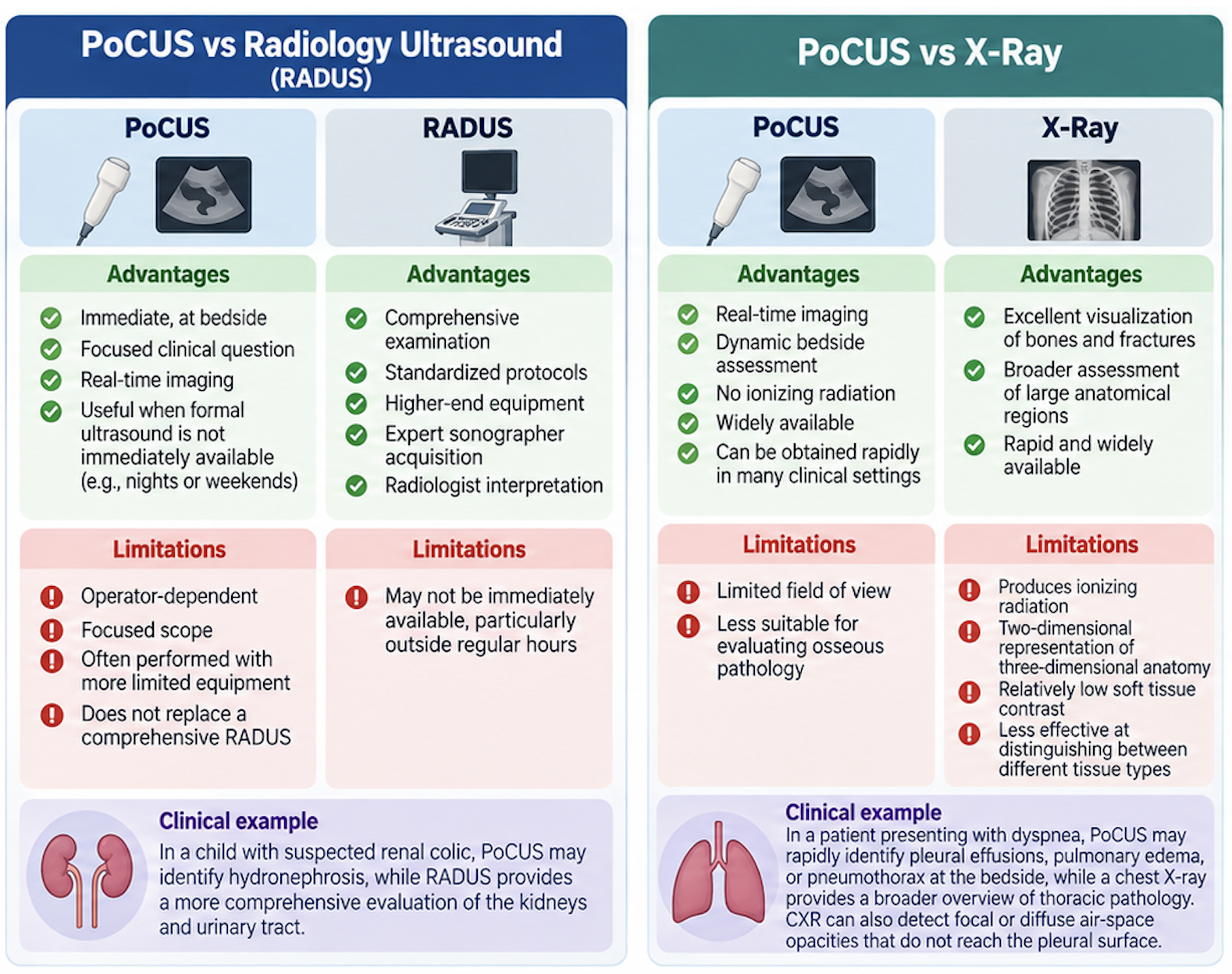
PoCUS vs Radiology Ultrasound (RADUS)
PoCUS is designed to answer focused clinical questions, while radiology ultrasound provides a comprehensive diagnostic examination.
- Advantages of PoCUS / Limitations of RADUS: PoCUS can be performed immediately at the bedside and integrated directly into patient care, particularly when formal ultrasound is not immediately available (e.g., nights or weekends).
- Advantages of RADUS / Limitations of PoCUS: RADUS provides a comprehensive examination using standardized protocols, higher-end equipment, sonographer expert image acquisition and interpretation by radiologists. In contrast, PoCUS is focused, operator-dependent, and often performed using more limited equipment. PoCUS does not replace a comprehensive RADUS.
- Clinical example: PoCUS may identify hydronephrosis in a child with suspected renal colic, while RADUS would provide a more comprehensive evaluation of the kidneys and urinary tract.
PoCUS vs Portable X-Ray
Both PoCUS and radiography are widely available and can be obtained rapidly in many clinical settings.
- Advantages of PoCUS / Limitations of X-ray: PoCUS provides real-time imaging without ionizing radiation and allows dynamic bedside assessment. In contrast, X-rays produce a two-dimensional representation of three-dimensional anatomy, have relatively low soft tissue contrast, and are less effective at distinguishing between different tissue types [3].
- Advantages of X-ray / Limitations of PoCUS: X-rays provide excellent visualization of bones and fractures and offer a broader assessment of large anatomical regions. PoCUS is more limited in its field of view and is less suitable for evaluating osseous pathology.
- Clinical example: In a patient presenting with dyspnea, PoCUS may rapidly identify pleural effusions, pulmonary edema, or pneumothorax at the bedside, while a chest X-ray provides a broader overview of thoracic pathology. CXR is also able to detect focal or diffuse air-space opacities that do not reach the pleural surface.
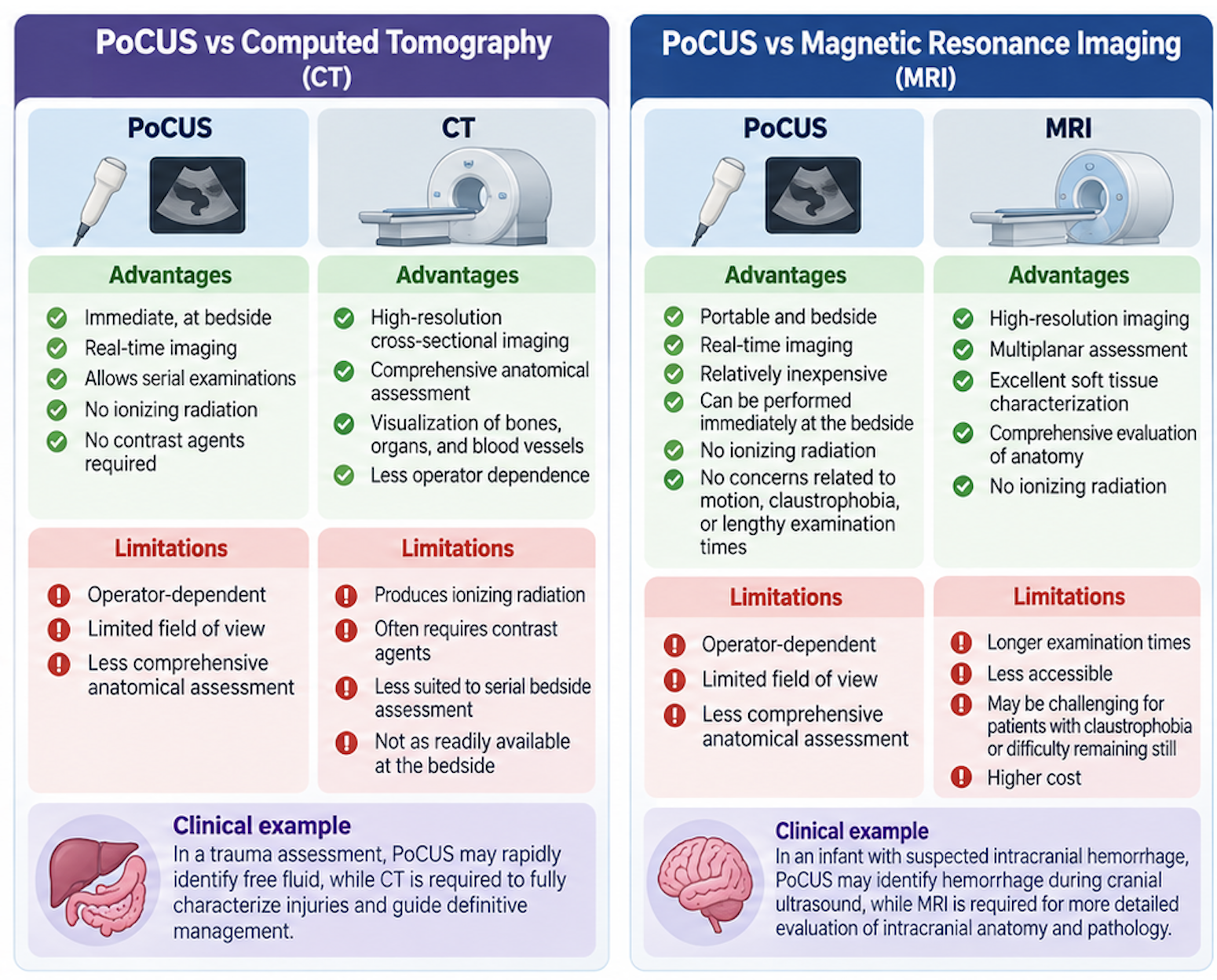
PoCUS vs Computed Tomography (CT)
CT provides detailed anatomical imaging and remains the gold standard for many diagnoses.
- Advantages of PoCUS / Limitations of CT: PoCUS can be performed immediately at the bedside, provides real-time imaging, allows serial examinations, and does not expose patients to ionizing radiation or contrast agents.
- Advantages of CT / Limitations of PoCUS: CT provides high-resolution cross-sectional imaging of bones, organs, and blood vessels and offers a more comprehensive anatomical assessment with less operator dependence [3]
- Clinical example: PoCUS may rapidly identify free fluid during a trauma assessment, while CT is required to fully characterize injuries and guide definitive management.
PoCUS vs Magnetic Resonance Imaging (MRI)
MRI provides detailed soft tissue assessment without ionizing radiation.
- Advantages of PoCUS / Limitations of MRI: PoCUS is portable, inexpensive, provides real-time imaging, and can be performed immediately at the bedside without concerns related to motion, claustrophobia, or lengthy examination times.
- Advantages of MRI / Limitations of PoCUS: MRI provides high-resolution multiplanar imaging with excellent soft tissue characterization and a significantly more comprehensive evaluation of anatomy.
- Clinical example: PoCUS may identify an intracranial hemorrhage during infantile cranial ultrasound, while MRI is required for more detailed evaluation of intracranial anatomy and pathology.
Downstream Clinical Decision Making
PoCUS findings should always be interpreted within the broader clinical context and used to guide subsequent management decisions. While PoCUS may identify important abnormalities or narrow the differential diagnosis, it does not replace formal diagnostic imaging or clinical decision making. Instead, PoCUS often helps determine which patients require additional investigations, specialist consultation, urgent intervention, or ongoing monitoring.
By providing timely bedside information, PoCUS can improve communication between healthcare providers and consulting services, facilitate appropriate referrals, and reduce the time required to reach the correct diagnosis and treatment plan [4].