
Goal: To reduce needle redirections and failed attempts
Indications
PoCUS guidance should be considered in children requiring a LP when any of the following factors are present:
· Neonate or infant <12 months of age
· Previous failed LP attempt(s)
· History of a difficult LP
· Poorly palpable bony landmarks.
· Mild scoliosis or altered surface anatomy without known spinal canal pathology.
· Obesity
Contraindications
PoCUS does not remove the standard contraindications to LP. Routine bedside PoCUS-assisted LP should be avoided or deferred in the following circumstances:
· Known spinal cord abnormality
> Tethered cord
> Low lying conus
> Other significant spinal canal abnormalities
· Bleeding diathesis or clinically significant coagulopathy
· Overlying infection/cellulitis
· Inability to safely tolerate flexed position
Equipment
· Ultrasound machine
· High frequency linear probe*
· Curvilinear probe**
· Sterile ultrasound gel
· Towels
· Marking pen
· Sterile LP kit
*A linear transducer with a full-length footprint (figure 1) is recommended for this examination. Some pediatric ultrasound systems have a short-footprint linear transducer; while useful for accessing small or confined anatomical regions, the short-footprint probe is not preferred for this examination because its shorter footprint may not provide sufficient coverage to visualize multiple adjacent spinous processes simultaneously.
**In pediatric patients, the high-frequency linear probe is generally suitable for both longitudinal and transverse landmarking. However, with obese individuals, the linear probe may not have enough penetration to see the relevant anatomy (spinous process) well in the transverse position, and such, the curvilinear probe may be used for transverse landmarking. The linear probe is used for longitudinal landmarking as it has a wider footprint and allows us to see several different spinous processes in one image.
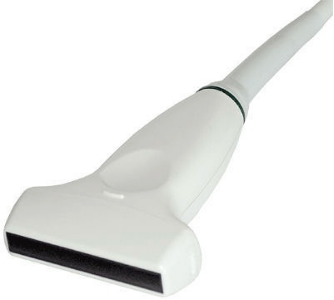
Figure 1. High frequency linear probe