
PoCUS is a skill that requires structured training and ongoing practice. Competence is not achieved through didactic teaching alone and should not be assumed based solely on course completion or theoretical knowledge. As a responsible PoCUS user, it is important to ensure adequate training, maintain competency, and recognize the limits of one’s abilities [1].
Competence in PoCUS extends beyond image acquisition and include the ability to:
A) Understand the clinical indications for the examination.
B) Have the skill to acquire diagnostic-quality images.
C) Have the ability to accurately interpret images.
D) Integrate findings into clinical decision-making.
[5, 7, 16, 17]
Competency is developed through a progression of didactic learning, supervised practice, longitudinal mentorship, formal assessment, quality assurance, and continued clinical use. Together, these components support the development of the knowledge, technical skills, image interpretation abilities, and clinical judgment required for safe and effective PoCUS practice.
Assuming competence without adequate training, assessment, and feedback can increase the risk of image acquisition errors, misinterpretation of findings, overconfidence in limited examinations, and inappropriate clinical decision-making.
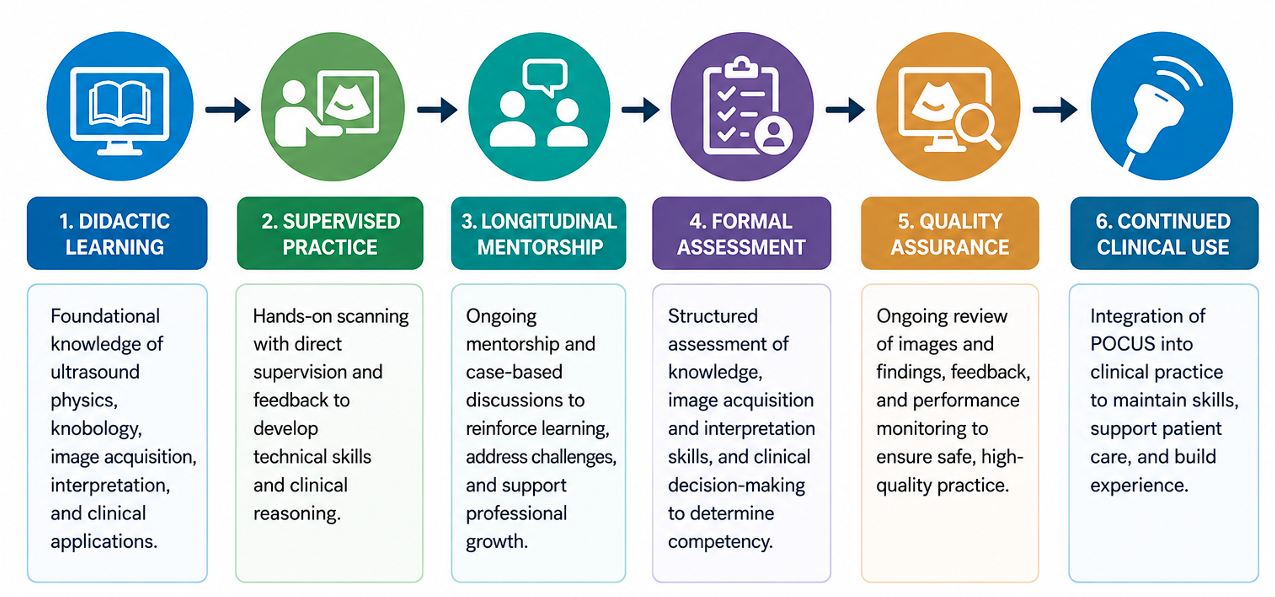 Figure 8. PoCUS training workflow